
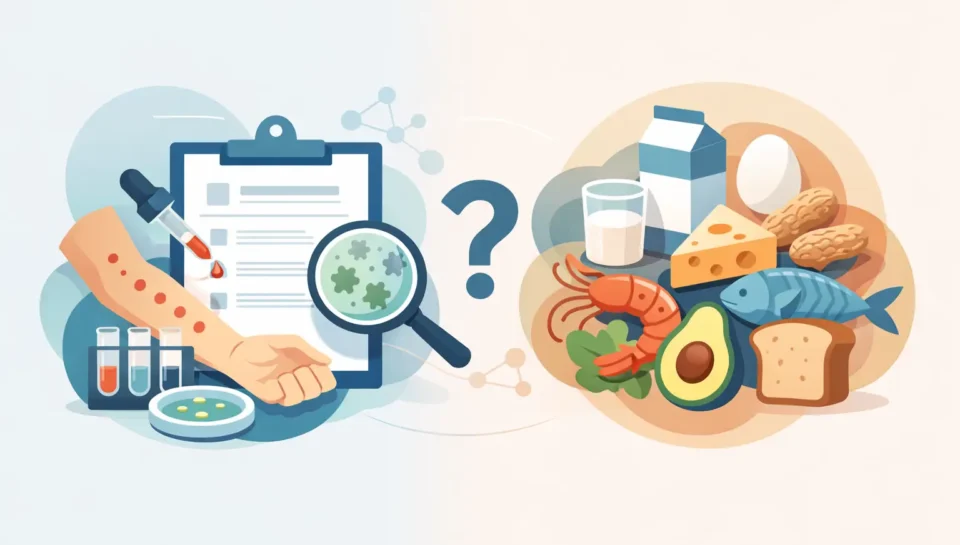
If you have ever looked at a food label while wondering why your stomach bloats, your skin flares, or your energy drops after eating, you are not alone. One of the most common questions people ask is: can an allergy test detect food intolerance? The short answer is no – not in the way most people hope. Allergy tests and food intolerance testing are looking for different reactions in the body, and understanding that difference can save a great deal of confusion.
Can an allergy test detect food intolerance, or are they different?
They are different, even though the symptoms can overlap.
A true food allergy involves the immune system reacting in a fast and sometimes severe way. This is often linked with IgE antibodies and can trigger symptoms such as swelling, hives, wheezing, vomiting, or in serious cases, anaphylaxis. These reactions usually happen quite quickly after eating the food.
A food intolerance tends to be slower, less dramatic, and often harder to identify. It may show up as bloating, constipation, loose stools, headaches, fatigue, brain fog, skin irritation, low mood, or a general sense that something is not quite right. Symptoms can appear hours later, and sometimes the problem is not one food on its own, but the overall burden on digestion and the immune system.
That is why people can spend months, or even years, trying to work out what is affecting them. The food may not cause a classic allergic reaction, but it may still be contributing to inflammation, digestive stress, or ongoing discomfort.
What an allergy test is designed to find
When a GP or allergy specialist carries out allergy testing, they are usually looking for immediate allergic reactions. This might be done through a skin prick test or a blood test that measures specific IgE antibodies.
These tests can be very useful when someone is reacting quickly and strongly to foods such as peanuts, shellfish, eggs, or dairy. If the concern is a possible allergy, especially where breathing, swelling, or severe symptoms are involved, proper medical assessment is essential.
But this is where many people get frustrated. They have a test, it comes back negative, and they are told everything is fine – yet they still feel unwell after eating. In reality, the test may simply have answered a different question. It may have ruled out an allergy, but it has not explained whether a food intolerance or sensitivity is present.
Why food intolerance is more complex
Food intolerance is rarely just about the food itself.
Sometimes the issue is enzyme related, such as lactose intolerance, where the body struggles to break down lactose properly. Sometimes it is about gut health, stress, poor digestion, hormonal changes, or a history of antibiotics, infections, or long-term dietary imbalance. In other cases, the body may be reacting to foods in a more delayed immune-related way.
This is why a simple yes-or-no model does not always work. Two people can eat the same meal and have very different outcomes. One may feel perfectly well, while the other develops bloating, cramps, fatigue, and a foggy head by the afternoon.
For many women over 30 in particular, symptoms can become more noticeable during times of hormonal change, stress, or burnout. Digestion can become less resilient, and foods that once seemed harmless may start to feel more difficult to tolerate.
Can an allergy test detect food intolerance in any indirect way?
Only indirectly, in the sense that it may help rule out a true allergy.
That can still be valuable. If someone is worried about a severe allergic reaction, identifying or excluding an allergy is an important first step. But a normal allergy test does not mean your symptoms are imagined, and it does not mean food is not playing a role.
This is an area where people often feel dismissed. They know their body is reacting, but standard allergy testing has not given them the answers they need. A more personalised approach is often required – one that looks at symptoms, timing, diet, digestion, lifestyle, and the wider picture of health.
What testing may be more relevant for food intolerance?
There is no single test that explains every possible food intolerance, because the causes are varied. That said, some forms of intolerance testing are used as part of a broader clinical picture, particularly when guided by an experienced practitioner.
Testing may be helpful when it sits alongside a thorough case history. On its own, any result can be misleading. A piece of paper is not the same as understanding your body.
This is one reason a holistic approach matters. Rather than focusing only on whether a food is good or bad, it asks deeper questions. How well are you digesting? Are you under chronic stress? Is your gut lining irritated? Are you eating in a rushed state? Are there patterns linked with hormones, sleep, or emotional strain? These details matter because they influence how the body responds.
At Ask Nutrition, this whole-person perspective is central to making sense of food-related symptoms. The aim is not simply to remove foods forever, but to understand why the body is struggling and what support may help restore balance.
The role of an elimination approach
For many people, one of the clearest ways to identify a food intolerance is through a structured elimination and reintroduction process.
This means removing suspected foods for a period of time, allowing symptoms to settle, and then reintroducing them carefully to observe the response. Done properly, this can be very revealing. It can also stop people from cutting out large groups of foods unnecessarily.
That matters, because over-restriction can create its own problems. It can increase anxiety around food, reduce nutritional variety, and leave people feeling confused about what is safe to eat. A guided process brings more clarity and less guesswork.
Still, elimination diets are not always straightforward. If someone is reacting to multiple foods, has a very inflamed digestive system, or is dealing with stress-related symptoms, patterns can be blurred. This is why support from an experienced practitioner can make the process more effective and less overwhelming.
When symptoms are not caused by intolerance alone
It is also worth saying that not every uncomfortable symptom after eating is a food intolerance.
Poor chewing, eating too quickly, low stomach acid, constipation, gut imbalance, IBS, fluctuating hormones, and stress can all make meals feel harder to cope with. A person may blame gluten, dairy, or sugar when the underlying problem is actually a digestive system that needs support.
That does not make the symptoms any less real. It simply means that removing foods may not be the full answer.
A thoughtful practitioner will look at both the trigger and the terrain. In other words, what seems to set symptoms off, and what is happening in the body that has made it more reactive in the first place. This is often where longer-term healing begins.
So, should you have an allergy test?
If you have rapid or severe symptoms after eating – especially swelling, breathing difficulty, hives, or signs of anaphylaxis – seek medical advice urgently. In that situation, allergy testing is absolutely appropriate.
If your symptoms are slower, more digestive, more inflammatory, or more difficult to pin down, an allergy test may not give you the information you are looking for. It is not the wrong test. It is simply testing for something different.
For ongoing bloating, fatigue, headaches, constipation, skin issues, or unexplained discomfort after meals, a more personalised food intolerance and digestive health approach is often more useful. That may include detailed symptom tracking, intolerance testing where appropriate, and support to improve digestion, reduce inflammation, and bring the body back into a steadier state.
The most helpful question is often not just, what food am I reacting to? It is also, why is my body struggling to cope right now?
That shift in perspective can be surprisingly powerful. It moves the conversation away from fear and restriction, and towards understanding, support, and practical change.
If you suspect food is affecting your health, trust the pattern you are noticing. Your symptoms are giving you information. With the right guidance, that information can become a pathway to better digestion, clearer energy, and a more comfortable relationship with food.