

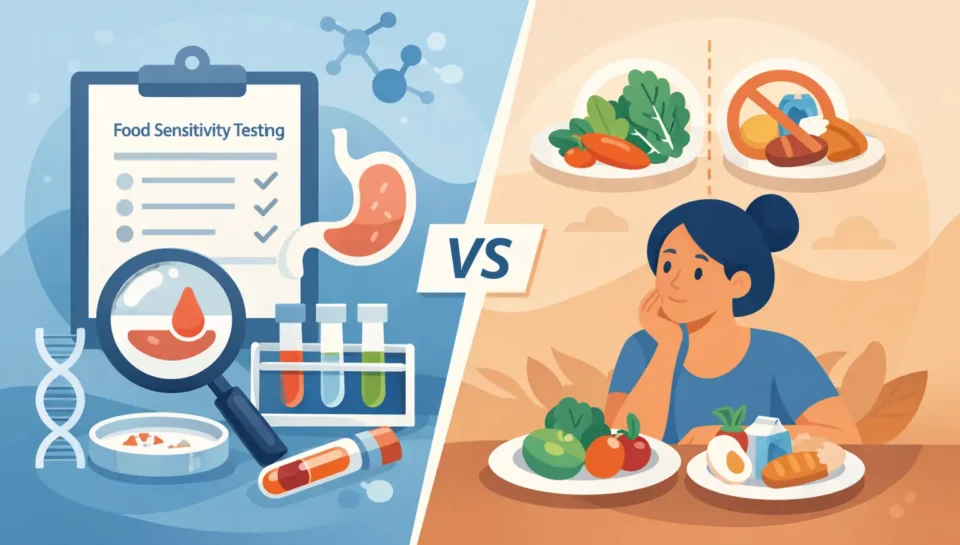
If you feel worse after meals but cannot pin down why, the question of food sensitivity testing vs elimination becomes very real, very quickly. One route offers a structured snapshot of possible triggers. The other asks for patience, observation and a willingness to simplify your diet for a period of time. Both can be useful. Neither is perfect. The right choice depends on your symptoms, your lifestyle and how much support you have around you.
Food sensitivity testing vs elimination: what is the difference?
At heart, these two approaches are trying to answer the same question: which foods may be contributing to symptoms such as bloating, wind, reflux, headaches, skin flare-ups, fatigue, brain fog or unsettled bowels?
Food sensitivity testing uses a testing method to identify foods that may be provoking a response in the body. Depending on the type of test used, this may measure immune activity or another biological marker linked to food intolerance patterns. It can give you a starting point and help narrow the field, especially if your symptoms seem broad, inconsistent or tied to many different foods.
An elimination approach works differently. You remove suspected foods for a period of time, allow the system to settle, and then reintroduce them one by one while observing your symptoms. This process can reveal whether a food is genuinely aggravating you, whether the reaction is dose-related, and whether your body can tolerate that food again once digestion and gut health improve.
The important point is that food sensitivity is not always the same as a true allergy. Food allergies can be immediate and serious, and they need medical attention. Sensitivities and intolerances are often slower, more cumulative and less obvious. That makes them frustrating, but it also means a careful, individual approach matters.
When testing can be the better starting point
For many people, testing feels less overwhelming than removing a long list of foods without a clear plan. If you are already tired, inflamed or confused by conflicting advice, having some guidance can be deeply reassuring.
Testing can be especially helpful if your symptoms have been rumbling on for months or years and you have lost confidence in your own judgement. It may also be useful if your diet is very varied and you cannot easily identify patterns, or if you suspect several foods are involved at once. In those cases, a test can provide a practical framework for what to focus on first.
There is also an emotional side to this. Many people with digestive symptoms start to fear food altogether. They begin cutting things out at random and end up eating a smaller and smaller range of meals. Thoughtful testing can reduce some of that guesswork. Instead of reacting from fear, you can make decisions with more clarity.
That said, a test result should not be treated as a life sentence. It is not a moral judgement on a food, and it does not mean you must avoid something forever. Very often, foods that show up as problematic are reflecting a body under strain – perhaps because of gut irritation, stress, poor digestion, hormonal shifts or a history of repeated antibiotic use. In that sense, the result is part of the picture, not the whole picture.
When elimination may tell you more
An elimination approach can be powerful because it shows you what happens in real life, in your own body, under normal eating conditions. It does not rely on a lab marker alone. Instead, it asks a simple but demanding question: how do you actually feel without this food, and what happens when it returns?
This can be especially useful if your symptoms are quite clear and repeatable. If every time you eat dairy you become bloated, congested or uncomfortable, a carefully managed elimination and reintroduction may give you the answer you need. The same can apply to gluten, eggs, soya, alcohol or highly processed foods.
Elimination also helps uncover thresholds. Some people do not react to a food every single time. They may be able to tolerate a small amount but not repeated servings over several days. Others react only when stressed, sleep-deprived or hormonally unsettled. Reintroducing foods methodically often reveals these nuances in a way testing alone cannot.
The challenge is that elimination requires consistency. If foods are removed for too short a time, or reintroduced too casually, the results can be muddy. It also becomes difficult if you are dealing with a history of disordered eating, anxiety around food or a very restricted diet already. In those situations, more restriction is not always the kindest or safest place to begin.
The limits of both approaches
This is where a balanced conversation matters. Testing can be helpful, but not all tests are equal, and results need experienced interpretation. A long list of reactive foods may reflect underlying gut dysfunction rather than permanent intolerance. If you simply remove everything without working on digestion, stress, inflammation and nutritional status, you may end up managing symptoms without resolving the reason they appeared.
Elimination can also be illuminating, but it is not flawless. Symptoms may improve because you are eating more simply, cooking at home and reducing additives or alcohol, rather than because one specific food is the culprit. Sometimes people feel better because they are finally eating regularly and paying attention to their body. That is valuable, but it can make the process less straightforward than it first seems.
There is another consideration: timing. If you are exhausted, peri-menopausal, under high stress, constipated or dealing with long-standing digestive imbalance, your reactions to food may be amplified. In those phases, the body can appear sensitive to many things. Once the nervous system settles, bowel function improves and the gut has support, tolerance often changes.
Food sensitivity testing vs elimination in practice
In clinic, this is rarely an either-or choice. Often the most sensible path is to use both, in the right order and with the right expectations.
A test can provide direction. An elimination phase can then confirm what is truly relevant. Reintroduction helps distinguish between foods that need a longer break and foods that may return in moderation later. This is a much more compassionate model than telling someone to avoid a dozen foods indefinitely.
For example, someone with bloating, skin irritation and low energy might use testing to identify likely pressure points, then remove those foods while also supporting digestion, bowel health and stress regulation. As symptoms calm, foods can be challenged one at a time. That process not only identifies triggers but also shows whether healing is improving tolerance.
This is one reason a whole-person approach matters so much. Food reactions are rarely just about the food. Chewing poorly, rushing meals, low stomach acid, disrupted gut bacteria, constipation, emotional stress and hormonal changes can all shape how the body responds. If those pieces are ignored, any plan can become unnecessarily restrictive.
How to choose the right approach for you
If you want a clear starting point and you feel lost, testing may be the more supportive first step. If your symptoms are predictable and you feel able to follow a structured diet trial, elimination may work well. If your relationship with food is already anxious or restrictive, professional guidance becomes even more important.
It also depends on your goal. If you simply want symptom relief as quickly as possible, an elimination plan may bring noticeable changes within weeks. If you want a broader picture of possible patterns, testing can help prioritise where to begin. If you want confidence, not just short-term relief, combining insight with careful reintroduction is often the most useful route.
For practitioners, the distinction matters too. Clients are far more likely to stay engaged when they understand why a food is being removed, how long the process will last and what the path back to tolerance may look like. Whether you are supporting your own health or guiding others, clarity creates trust.
At Ask Nutrition, this is approached with the understanding that symptoms do not exist in isolation. Digestive discomfort, fatigue, mood and resilience often travel together. The aim is not to create fear around food, but to help people understand their body with more confidence and care.
If you are weighing up food sensitivity testing vs elimination, try not to think in terms of which is better in the abstract. Ask which one gives you the clearest, kindest next step. The best approach is the one that helps you feel calmer in your body, more informed in your choices and less trapped by symptoms.